
March 2024
The UK Green Building Council (UKGBC) has unveiled a comprehensive framework for the measurement and reporting for the retrofit of commercial buildings. This framework is designed to furnish businesses with a standardised methodology to prioritise the retrofit of existing assets to net zero, while ensuring they have long-term strategies in place that maximise co-benefits and minimise unintended consequences. Thereby supporting the nation’s commitment to achieving net-zero targets.
Retrofitting is the process of upgrading or modifying existing structures. This can be done to improve energy efficiency and reduce carbon emissions through operational energy performance as measured using an EPC, whilst accounting for whole life carbon emissions, and projected returns on investment. The benefits of retrofitting extend beyond immediate energy savings to the owner/occupier, and can accommodate advancements in health, wellbeing and social value.
Through this report, UKGBC shows the importance of retrofitting office buildings to achieve a 59% reduction in energy consumption within this sector by 2050 to meet UK net zero targets. This methodology is highlighted in the three options below, which offer tangible benefits in terms of cost savings, environmental responsibility, and improved working conditions, making it an important choice for building owners and businesses alike.
Optimisation – BMS upgrade / health check. • Reduce tenant equipment loads.
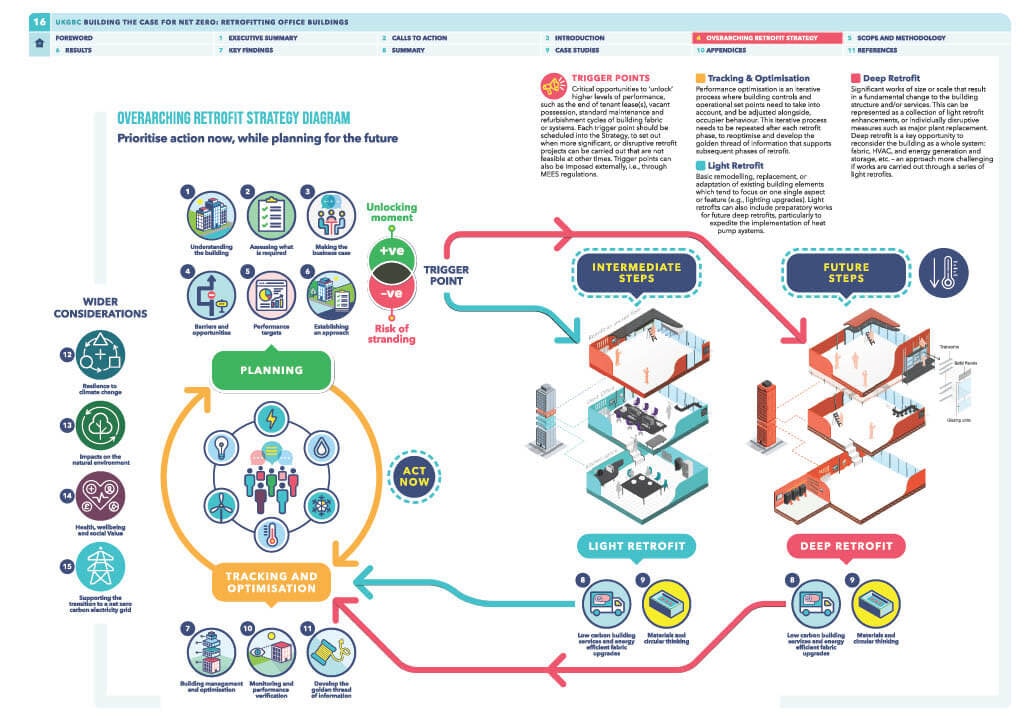
Light Retrofit – Pump motor replacement •Lighting controls •Low energy lighting
Deep Retrofit – Roof insulation •Building airtightness •Wall insulation •Window replacement • Decarbonisation of heat (ASHP) •ASHP for DHW
Figure 1. UKGBC finds significant opportunities being missed to retrofit commercial buildings | UKGBC
Significant reductions in operational energy use are possible through both optimisation and light retrofit (26% and 15% respectively or 37% combined), which generally include the most cost and carbon-effective retrofit measures. Optimisation and light retrofit can be landlord or tenant-led, and success depends on effective collaboration between all stakeholders. Deep retrofit is generally required to achieve significant cuts in operational energy use (60-65%), involving more substantial upgrades to a property.
Importance of retrofitting in the built environment
The UKGBC’s framework provides valuable insights for asset-owning businesses or individuals concerned about understanding the physical risks of climate change. It creates awareness for building owners and stakeholders who may not be fully aware of the benefits of retrofitting, or the potential funding opportunities available to support this. Average retrofit projects being carried out at this time are not reaching the reductions in operational energy performance required to meet top-down sectoral net zero targets. Efforts need to be redoubled and ambitions raised, to ensure the decarbonisation potential of future retrofit opportunities are realised.
Large commercial building stakeholders possess the potential to lead by example in implementing retrofit strategies, to improve energy efficiency and contribute to the reduction in energy consumption within the office sector. Addressing these challenges will require a holistic approach, involving collaboration between government bodies, industry stakeholders, and guidance frameworks such as this UKGBC one, to create an environment where retrofitting office buildings is at the forefront of businesses.
Key considerations for our clients
The UKGBC’s framework highlights the importance of long term optimisation because it will change the way we use our offices, as building performance is balanced with employees’ health and wellbeing, shifts in flexible working, and alternative approaches to how, when, and where we work. Collaboration across all stakeholders is key to ensure all parties are invested in a net zero focused outcome, and that any unintended consequences of workplace shifts are fully considered. It represents a strategic investment, yielding financial savings, environmental advantages, and enhanced overall building performance, as delineated in the ten proposed strategies:
- Efficiency: Installation of modern technologies to reduce energy consumption and operational costs.
- Environmental Impact: Lowering carbon emissions and minimising the ecological footprint.
- Cost Savings: Long-term energy and operational cost savings.
- Compliance with Regulations: Ensuring adherence to evolving environmental regulations and building codes.
- Improved Comfort and Productivity: Enhancing indoor environments for occupants, positively impacting well-being and productivity.
- Increased Property Value: Conforming to evolving standards to avoid penalties and legal issues.
- Adaptation to Changing Needs: Reconfiguring spaces to accommodate evolving requirements and technologies.
- Technological Integration: Incorporating smart building technologies for enhanced operational efficiency.
- Long-Term Sustainability: Integrating sustainable practices for enduring building management.
- Government Incentives: Availing incentives and subsidies to offset initial costs and promote sustainable practices
How can Envision help?
Retrofitting office buildings is imperative for addressing energy efficiency, carbon emissions and the evolving needs of businesses. Envision offers asset-owning businesses guidance in assessing and measuring the physical risks of climate change by establishing Net-Zero Pathways and Strategies, Asset Decarbonisation Plans, EPC Improvement Studies, BREEAM-In-Use benchmarking and Life Cycle Assessments, all of which support portfolio level disclosures such as GRESB Our services align with the reporting requirements set forth by the UKGBC framework, empowering clients to make informed decisions for the future.
Phoebe Charnley