• Skip to main content
  • Skip to primary sidebar

Out now! Read the Spring 2025 edition of Rank Ripples magazine.

Rank-Foundation-Logo
  • About Us
    • Our People
    • Partnerships
    • Our Data & Impact
    • Work with us
  • Our Approach
    • Community
    • Enterprise
    • Leadership
    • Faith
  • Where We Work
    • Dundee
    • Sunderland
    • Plymouth
  • Coworking Space
  • What’s New?
    • News
    • Podcast
    • Magazine
  • Contact
Sign in to RankNet
Search field required
Rank-Foundation-Logo
  • About Us
    • Our People
    • Partnerships
    • Our Data & Impact
    • Work with us
  • Our Approach
    • Community
    • Enterprise
    • Leadership
    • Faith
  • Where We Work
    • Dundee
    • Sunderland
    • Plymouth
  • Coworking Space
  • What’s New?
    • News
    • Podcast
    • Magazine
  • Contact
Sign in to RankNet

leadership

Ripples Story: “Giving a Voice to Everyone”

November 4, 2024 by Nhung Phung Leave a Comment

In this article, Aimee Thorpe Mundt, Community Development and Engagement Assistant at the Why Not? Trust, explores what it means to lead inclusively and how it can create a workplace where everyone, regardless of background or experience, has equal opportunities to thrive. 

Inclusive leadership helps a workplace to run smoothly and fairly, and in this article, I explore what it means to me. Inclusive leadership allows people with different life experiences to have a voice and share their valuable opinions. It ensures that no matter who you are, what you look like, what your beliefs are, or where you are from, you have equal opportunities within your workplace.

I work with the Why Not? Trust for care-experienced people. This group often experiences stigma and discrimination for various reasons, including, but not limited to, the idea that they did something wrong and that’s why they were in care, that they are troubled or troubled, and that they are broken or unfixable, so not worth the effort.

It is important to note that most people who enter the care system do so through no fault of their own. Inclusive leadership within my workplace brings us all together to work towards the same goal: ensuring that care-experienced parents and students have the support they need to thrive.

Inclusive leadership is flexible

One way we’ve made the workplace more inclusive is through hybrid working. Most of us work from home and attend in-person events when required. This ensures everyone has an equal opportunity to a good home and work-life balance, which means everyone can bring their best selves to support the people we work with. Personally, I am experiencing some health issues and undergoing health testing. Workplace flexibility ensures that I can attend appointments. I am not scrambling to make up work hours at random and unsocial hours.

In turn, this means that I’m as healthy and rested as possible when I’m working instead of feeling more unwell from feeling overworked and tired! This is offered to all staff, and I see its benefits.

Inclusive leadership allows all voices to be heard

As a care-experienced person myself, and the only person on my team to be a part of The Village – a digital community for new parents and parents-to-be with experience of care – as a Villager (person who is a care-experienced parent) and as a staff member, I need my voice to be heard. Although I am the minority in the room, my direct experience of the care system is valued highly, as my experiences can directly inform the work that we are doing.

Within staff meetings, our leadership gives each member of staff time to share what they’ve been doing and ask for support with anything that’s needed. Within my assigned project, Wee Campus, which supports care experienced students in further and higher education, we allow opportunities for equal participation; I have developed a private Facebook group to allow students to connect, share and support each other. We have a weekly drop-in session online to allow students to come and talk to us, ask questions, get support, or let off some steam.

Fostering this idea of inclusive leadership allows me to participate in my workplace and project this inclusion onto those I work with. Making as many opportunities as possible to allow voices to be heard is what makes The Why Not? Trust operates so smoothly.

Filed Under: Leadership, RankNet Tagged With: EDI, inclusive leadership, leadership

Ripples Story: “Inclusive Leadership is Essential to Social Sector”

November 3, 2024 by Nhung Phung Leave a Comment

In this article, Jen McKevitt, Rank’s very own Associate Director for Sunderland and the North East, describes how inclusive leadership is fundamental to the work of social leaders in the voluntary, community and social enterprise (VCSE) sector, and offers some strategies to achieve it.

Inclusive leadership is fundamental to our work as social leaders in the voluntary, community and social enterprise (VCSE) sector. Many of us might believe that inclusivity is part of our ideological make-up, social sector DNA, and raison d’etre. It is a cornerstone for addressing social inequity and structural inadequacies, building social capital, increasing community resilience and regenerating left-behind communities.

Many of us work hard year in and year out to build inclusive communities, but is it becoming more challenging? Are the issues and needs changing? Might it be argued that what’s been happening in some of our communities in terms of racially motivated hate crime and mob violence requires us to pause, reflect and rethink?

Truly inclusive leadership, particularly in communities of place, is arguably even more essential than ever in building cohesive, resilient and sustainable communities. Recognising and combating hate crime, fear, xenophobia and racially motivated hate crimes, such as those seen in many of our communities recently, must be part of that developmental process. Creating welcoming and inclusive environments, as many community anchor organisations have done for decades, provides a solid platform to help us serve our communities, make informed decisions, and achieve lasting impact.

But as social leaders, should we be doing more? Do we fully understand our communities, and are we taking account of demographic changes? What is shifting? Have tensions been building? What can we do to acknowledge a possible increase in fear and distrust? What can we do to remove barriers and build cohesion?

How can we build inclusive leadership in communities affected by hate crime?

Above: Jen, left, with Rank’s trustees and Sunderland-based Network members

Some of us may remember the days when there was the odd seasonal ‘quiet spell’, when we had a chance to pause, reflect, consider environmental, social and economic changes, consult, plan and garner resources to meet new needs. That luxury seems to be a thing of the past, but, as we did during COVID-19, a strength of the VCSE is our ability to recognise shifting needs and do what’s required because we simply should. Inclusive leadership is crucial in areas that have experienced hate crimes and riots. It fosters unity, trust, and understanding, which is essential for healing and preventing future incidents. Here are some strategies to consider:

Create space and empower staff, volunteers and trustees to reflect and question assumptions

  • Foster open dialogue and encourage respectful exchange of thoughts, ideas and understanding.
  • Use inclusive language that avoids stereotypes and biases.
  • Explore unconscious bias and reaffirm socially equitable value systems.

Engage those who are marginalised, demonstrate empathy and understanding through

  • Active listening to demonstrate a genuine interest in understanding the experiences and perspectives of individuals from diverse backgrounds.
  • Recognise and validate the emotions of those affected by hate crimes/riots.
  • Show respect for different cultures, beliefs, and values.
  • Promote equity and fairness in policies and practices. For example, build a pipeline of inclusive talent development by empowering individuals from diverse backgrounds to develop their skills and take on leadership roles.

Education and awareness

  • Educate the community about hate crimes and their impact. Promote education and peacebuilding initiatives to address underlying causes of conflict.
  • Promote tolerance and respect for diversity.
  • Provide training, mentoring and guidance in a supportive, non-judgemental environment.
  • Train individuals to intervene safely when they witness hate crimes or discriminatory behaviour.
  • Actively seek input from marginalised people to shape services and inform decision-making.

Organise inclusive services and events

  • Bring people together from diverse backgrounds and seek their input in planning and delivery
  • Reach out to and support all marginalised people.
  • Collaborate and build partnerships with community organisations that work with refugees, asylum seekers and immigrants, faith leaders, and other stakeholders to build bridges and foster unity.

Rank’s network of leaders can create or rebuild vibrant, resilient, and equitable communities by fostering trust, empowerment, and social infrastructure.

Filed Under: Leadership, RankNet Tagged With: EDI, inclusive leadership, leadership, resilient communities, social impact, social sector, unity, VCSE sector

Ripples Story: “Creating Opportunities”

November 2, 2024 by Nhung Phung Leave a Comment

In this article, Emma Pears, Founder & CEO of SELFA, explains how she creates opportunities for people to do great things. For Emma, inclusive leadership is about creating an environment where people feel safe to do their best work.

It took me a long time to see myself as a leader. Traditional models of leadership weren’t really something I identified with: those that told a narrative that people born into strong families of leaders are also destined to be leaders or that leaders are people who outline tasks and goals to their team and tell them how to achieve them.

I see myself more often as an inclusive leader who creates opportunities for people to do great things. It’s not about dictating, sending down orders, or micromanaging. It’s about creating an environment where people come in and really want to do their best work.

At SELFA Children’s Charity, our vision is a community where children and young people are celebrated and know they belong. I feel that if we celebrated each other more as a society, the world would be a better place! That, to me, is what inclusive leadership is all about—celebrating others and creating cultures where people feel safe to be responsible for their actions.

Very rarely do I feel like I need to lead from the front; one of the few times was during the global pandemic in 2020. People were looking to me for answers in a very scary world, and I needed to give them the safety and security that I was there for them as a leader. Even though I did not have all the answers, I showed that it was OK to be a vulnerable leader who would ensure that we got through those difficult times together.

However, most of the time, I lead from behind and let the SELFA team, our children, and young people get on with it. I honestly believe that is why our team is so strong.

When people come into our organisation, they often don’t know who the CEO is immediately because we are all celebrated as leaders and trusted to do our jobs. We are here to serve our children and young people, help amplify their needs, and support them in finding solutions to the issues they face.

Above: Emma with two young SELFA clients

Relationships are at the centre of everything I do, so the most important thing I do as a leader is to connect with other people and build a foundation of trust. Before people decide whether they want to put their trust in SELFA, they first decide what they think of me. They judge me—they think, “Can I trust this person?”

Lived experience leadership

I also think my lived experience is a really important part of who I am as an inclusive leader. Whether it is as the mother of a child with mental health support needs, the daughter of an alcoholic, or a single mum for nearly a decade, all of these have been great roles in which I’ve practised the traits of inclusive leadership. It helps me advocate for children and young people who have also faced similar experiences and support them to become inclusive leaders within our community.

I still make mistakes pretty much every day! These days, I question my ideas rather than who I am. I am comfortable saying things like, “I’m sorry I didn’t see it that way; you’ve made me change my mind.” I try to de-stigmatise failure by stating up front that it’s OK to get things wrong, and I use language like, “This is the messy part where learning takes place,” rather than finding blame for “mistakes.”

I admit that I don’t have all the answers, and I ask other people to help me come up with them. By asking open questions, I actively listen to understand rather than respond.

The best legacy I can leave as an inclusive leader is when children and young people exercise authority over themselves and others; developing their leadership skills is at the heart of everything I do.

Filed Under: Leadership, RankNet Tagged With: inclusive leadership, leadership, SELFA

Learning Through Leadership Talk – April 2024

April 17, 2024 by Nhung Phung Leave a Comment

Leadership in a Judicial setting with Sir James Dingemans (Class of 1980)

In this blog post, Geoffrey Pelham-Lane, our Fellow (Class of 1978), shares his thoughts on our recent Learning Through Leadership talk, “Leadership in a Judicial Setting,” featuring Sir James Dingemans (Class of 1980). The event took place on 17th April 2024 at The Rank Foundation’s offices in Shoreditch, London.

Sir James Dingemans giving the talk

Sir James Dingemans

If there is someone who has most successfully realised the leadership potential that the Rank Foundation looks for in each of its School Leadership Award holders it is the Court of Appeal judge, Lord Justice Dingemans.

The person from Rank who first recommended him for an award in 1980 demonstrated remarkable foresight. Sir James’ talk on Wednesday evening did everything to confirm this as well as highlighting the value that the Rank Foundation has added and continues to add through its great work in bringing out the very best in people and society.

His talk on “Leadership in a Judicial setting” was hugely engaging not just to our next generation of fellows pursuing or about to pursue a legal career but also to all of us who benefit either directly or indirectly from the UK having one of the most envied and fair legal systems in the world. This achievement has clearly been no accident, having been built and sustained by the professionalism, impartiality and, most importantly, leadership of our lawyers.

Sir James described how he had developed professionally since receiving Rank support in his last year at Radley, learning about leadership when he trained at Sandhurst on a short service commission and then about the law when he studied at Oxford University. What was striking about his talk was not just how he applied these skills successfully to lead and motivate over 800 judges, but just how applicable these skills are to leadership elsewhere.

He referred to ‘Transactional’ leaders that work within the establishment and ‘Transformational’ leaders that typically inspire us with a charismatic vision. He discussed other styles such as ‘Situational’ leadership where a true leader adapts to the specific demands of a situation. This, he felt, was most applicable to leadership in the judiciary.

He provided examples of why it is important as a leader to identify your goal but keep it simple, show that you are capable of doing the job of those that you are leading (it is a requirement that judges have to be practitioners unlike managers in the NHS), make sure you do the right thing (don’t simply lead to satisfy media coverage), ensure you stay calm, respect boundaries (such as the law), learn to handle pressure and recognise your team (‘walk the floor’ and say ‘thank you’).

He also mentioned how important diversity is to achieving the best results and how, while the judiciary has made some improvements, this will take time as judges can only come from practitioners entering the law at the beginning of their legal careers.

All in all, a great talk and one where everyone, not just budding lawyers, learnt something. Thank you, Sir James!

About the author:

Geoffrey Pelham-Lane, Fellow (Class of 1978), is one of the UK’s leading financial communications experts, with more than 35 years of experience in financial PR and investor relations. He is Chairman of APCO UK and Chief Executive Officer at Capital Market Communications Ltd (Camarco), an APCO Worldwide Company.

Filed Under: Fellowship, Leadership, News, School Leadership Award Tagged With: fellowship, Fellowship Event, leadership, leaning through leadership, Rank Fellowship, sir james dingermans

Community Action Placement: Unlocking Leadership Opportunities

February 16, 2024 by Nhung Phung Leave a Comment

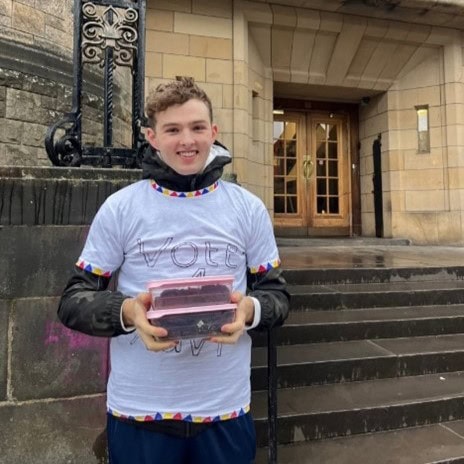
In this blog post, Xavier Lake (School Leadership Award Holder, Class of 2020) reflects on the impact of the award – especially his Community Action Placement – on his leadership opportunities at Glasgow University where he is a member of the University Union Board of Management (GUU).

I embarked upon my journey with the GUU by applying as a Fresher’s Helper and following a successful interview, I was employed in the role. My time with the Rank Foundation, especially my Community Action Placement (CAP) in Hexham, heightened my awareness of making a positive impact on the society around me.

In turn, as a Fresher’s Helper I widened my own sense of being part of the university’s community as I began my work not knowing anybody but by the end, I had made friends across all year groups and faculties and worked with salaried university staff members.

I strongly believe that the CAP gave me the confidence and drive to do this and showed me I truly enjoy helping others as it gives me a great sense of reward and motivates me to find other opportunities make a difference.

The election competition began almost immediately so I had to formulate my manifesto, campaign, and persuade my friends to help me. My leadership skills were most definitely called into action. The Rank Foundation’s belief in my skills as a leader enthused me to approach other students to discuss my manifesto and have fun with it!  I was over the moon when I was successfully elected to the board.
 
Holding office within the GUU has alerted me to the need to understand and process the multi-faceted issues that arise, such as: accessible study places, financial problems, course resources, allegations of misconduct, event planning, even helping when students have a bit too much to drink! I am then duty bound to meet with senior members of the university to eloquently explain matters to them with the aim of making impact to bring about positive change and feedback their responses to the union membership.

I feel my drive to make a difference for others was deepened and became a core value for me after the CAP at the Hexham Youth Initiative, seeing the joy and happiness that young people gained form the staff’s dedication has left a lasting impression upon me to help others where I can.

I am extremely grateful for the knowledge and progress that the Rank Foundation’s School Leadership Award has furnished me with, as I know I would not be following the path I am on without the confidence and self-belief the programme gave me.

On reflection, the essential ingredient that unlocked my confidence was completing the CAP because it took me far from home, placed me among strangers and into a job I had not done before. I loved my time in Hexham and was warmly welcomed. I am proud of my CAP and dearly hope you will be too!

Filed Under: Community Action Placement, Leadership, School Leadership Award Tagged With: cap, Community Action Placement, glasgow university, guu, hexham youth initiative, leadership, School Leadership Award

Learning Through Leadership Talk 2023

March 21, 2023 by Nhung Phung Leave a Comment

‘If not you then who?’: Rose Fitzpatrick CBE QPM

In this blog post, John Hind, our Director of Education and Leadership, shares his thoughts on our recent Learning Through Leadership talk, “If not you then who?” by Rose Fitzpatrick CBE QPM. The event took place on 21 March 2023.

Rose Fitzpatrick CBE QPM giving the talk

Late March saw a first as the Fellowship’s ‘Learning through Leadership’ programme transferred to Rank’s Garden Walk Headquarters. Those present were privileged to hear Rose Fitzpatrick, Foundation trustee and member of the Fellowship Leadership Team, share her experiences of over 30 years of service in the City and Met Police forces, culminating in her role as Deputy Chief Constable of the newly formed Police Scotland service in 2013.

A pioneering meeting at Garden Walk chimed with pioneering aspects of Rose’s career. A Theology and Philosophy graduate, she joined the city police at a time when only 2% of recruits held degrees and only 8% were women. As a relatively mature recruit with clear potential she was promoted to inspector in less than five years when the average time taken was ten. Her role with the City force was challenging: the force’s counter-terrorist role being stretched by incidents such as the Bishopsgate bomb, but it was the impact of the Macpherson report following Stephen Lawrence’s murder that persuaded Rose that her real passion was for community policing. Transferring to the Met force as a Superintendent, she became the Borough Commander for Tower Hamlets in 2002 as at that time the only female officer in such a position in the Met force. 

Her description of working in a diverse ethnic community as ‘mind blowingly interesting’ is testament to her commitment to true community work and it was this interest that took her out of a very brief retirement from her service into her role in Police Scotland.  Here – pioneering again – she faced the challenge of how best to make the new unitary national force address the differing needs of its various component communities – the needs of policing in Glasgow, for example, being radically different from those in Highland communities. Five years of facing the cultural and political challenges inherent in her role left her fulfilled but exhausted though a second retirement was even shorter than her first. Two days into her family holiday she was asked to establish and chair a new National Suicide Prevention Leadership Group for Scotland, a role which she still holds.

In all of this, a clear part of the answer to Rose’s title question lies in the manifest sense of duty and service that clearly drives her. Indeed, a crucial point she made was the need to reflect before taking on some challenges and to recognise when others may be better placed to take them on. Listening to one’s instinct was vital in such cases and Rose made the point that one can practise this, not least when facing up to the ethical and moral challenges leadership presents. Avowedly assuring us she was not the hero who ran into danger – though some of her colleagues were – she nonetheless showed real moral courage on a number of occasions when determined to do what she believed to be the right thing – even at the cost of temporary unpopularity. That leadership can be lonely is true – especially in situations where one has to stand up for one’s principles – and this was compounded for Rose by the lack of female peers at her level within the organisations she served. She did however make the point that asking for help is vital when facing challenging decisions is in no sense a sign of weakness: rather, it is a way of developing strengths.

Rose spoke on the day the Casey report into the Met police was published. Clearly digesting the report in full was impossible: however, in response to questions from a thoughtful and engaged audience, she did stress the need for proper resourcing of the police service, especially with regard to recruitment, vetting and training. In keeping with our theme, appropriate leadership is vital too. Looking back on all Rose said, it was clear that her moral purpose and sense of duty, coupled with a genuine understanding of the importance of the police’s relationship with their community, made her the kind of leader the police need. Those of us present were fortunate indeed to hear what she had to say.

About the author:

John Hind joined the Rank Foundation in June 2021 as Director of Education and Leadership. He is responsible for overseeing the School Leadership Award and Fellowship, following a career in teaching, most recently as Principal of Dame Allan’s Schools in Newcastle-upon-Tyne from 2004 to 2020. John studied history at Cambridge University, completed an MEd at Newcastle, and a part-time PhD at Durham.

Filed Under: Fellowship, Leadership, School Leadership Award Tagged With: fellowship, Fellowship Event, leadership, leaning through leadership, Rank Fellowship, Rose Fitzpatrick CBE QPM

  • « Go to Previous Page
  • Page 1
  • Page 2
  • Page 3
  • Page 4
  • Go to Next Page »

Primary Sidebar

Recent Posts

  • Rank Network visit to Northern Ireland: Backing local leaders, building stronger communities
  • Rank Ripples – Spring 2025 Edition
  • Ripples Story: “Investing in Experience”
  • Blog Post: “­My time at the Rank Foundation: Supportive Leadership”
  • Blog Post: “A New Chapter – My First Steps as a Time to Shine Leader”

Recent Comments

  1. Covid19: Funding support available in Torfaen | TVA - Torfaen Voluntary Alliance on COVID-19 Update

Archives

  • May 2025
  • April 2025
  • March 2025
  • January 2025
  • December 2024
  • November 2024
  • October 2024
  • September 2024
  • August 2024
  • July 2024
  • June 2024
  • May 2024
  • April 2024
  • March 2024
  • February 2024
  • January 2024
  • December 2023
  • October 2023
  • August 2023
  • July 2023
  • June 2023
  • May 2023
  • April 2023
  • March 2023
  • January 2023
  • October 2022
  • May 2022
  • April 2022
  • February 2022
  • January 2022
  • November 2021
  • October 2021
  • April 2021
  • December 2020
  • November 2020
  • October 2020
  • September 2020
  • August 2020
  • July 2020
  • June 2020
  • May 2020
  • April 2020
  • March 2020
  • October 2019
  • August 2019
  • July 2019
  • May 2019
  • April 2019
  • March 2019
  • January 2019
  • December 2018
  • October 2018
  • August 2018
  • July 2018
  • May 2018
  • April 2018
  • March 2018
  • February 2018
  • July 2017
  • May 2017
  • March 2017
  • January 2017
  • December 2016
  • November 2016
  • October 2016
  • September 2016
  • August 2016
  • July 2016
  • June 2016
  • May 2016

Categories

  • Community Action Placement
  • Coworking Space
  • Dundee
  • Enterprise
  • Fellowship
  • Hull
  • Leadership
  • News
  • Place-based News
  • Plymouth
  • Profit for Good
  • Rank Aspire Programme
  • RankNet
  • School Leadership Award
  • Start Here
  • Sunderland
  • Time to Shine

Language

  • Cymraeg
Rank-Foundation-Logo
  • About Us
  • Our Approach
  • Where We Work
  • Coworking Space
  • News
  • Contact
Sign in to RankNet

For enquiries about our
Coworking Space in London:

booking@rankfoundation.com

For Rank Network members:

ranknet@rankfoundation.com

For all other enquiries:

contactus@rankfoundation.com Please note we don't accept unsolicited applications for funding.

© 2026 The Rank Foundation.
All rights reserved.

Privacy Policy  Cookies  Complaints Policy

Made by erjjio and powered by
100% renewable energy

Green_Website_Black (2)
Manage Consent

To provide the best experiences, we use technologies like cookies to store and/or access device information. 

Functional Always active
The technical storage or access is strictly necessary for the legitimate purpose of enabling the use of a specific service explicitly requested by the subscriber or user, or for the sole purpose of carrying out the transmission of a communication over an electronic communications network.
Preferences
The technical storage or access is necessary for the legitimate purpose of storing preferences that are not requested by the subscriber or user.
Statistics
The technical storage or access that is used exclusively for statistical purposes. The technical storage or access that is used exclusively for anonymous statistical purposes. Without a subpoena, voluntary compliance on the part of your Internet Service Provider, or additional records from a third party, information stored or retrieved for this purpose alone cannot usually be used to identify you.
Marketing
The technical storage or access is required to create user profiles to send advertising, or to track the user on a website or across several websites for similar marketing purposes.
Manage options Manage services Manage {vendor_count} vendors Read more about these purposes
View preferences
{title} {title} {title}