• Skip to main content
  • Skip to primary sidebar
Logo - coloured
  • What We Do
  • Who we are
    • Our story
    • Our people
    • Join our team
  • Who we work with
    • Investors and operators
    • Design teams
    • Contractors
  • In practice
  • News
  • Contact
Logo - coloured
  • Home
  • Sustainability Consulting
  • Who we are
    • Our story
    • Our people
    • Join our team
  • Who we work with
    • Investors and operators
    • Design Teams
    • Contractors
  • In practice
  • News
  • Contact

Simon Rainsford

Importance of Retrofit in Commercial Buildings

March 15, 2024 by Simon Rainsford Leave a Comment

March 2024

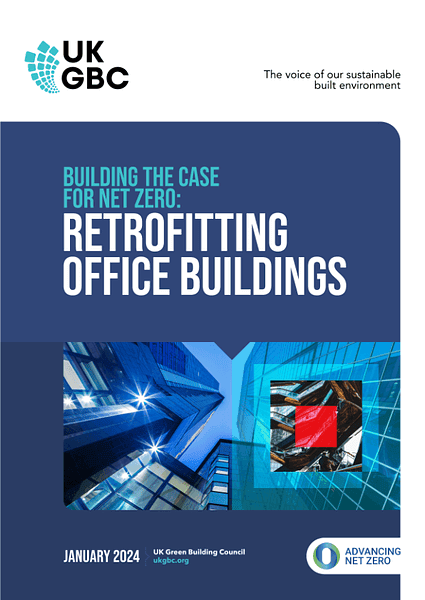
The UK Green Building Council (UKGBC) has unveiled a comprehensive framework for the measurement and reporting for the retrofit of commercial buildings. This framework is designed to furnish businesses with a standardised methodology to prioritise the retrofit of existing assets to net zero, while ensuring they have long-term strategies in place that maximise co-benefits and minimise unintended consequences. Thereby supporting the nation’s commitment to achieving net-zero targets.

Retrofitting is the process of upgrading or modifying existing structures. This can be done to improve energy efficiency and reduce carbon emissions through operational energy performance as measured using an EPC, whilst accounting for whole life carbon emissions, and projected returns on investment. The benefits of retrofitting extend beyond immediate energy savings to the owner/occupier, and can accommodate advancements in health, wellbeing and social value.

Through this report, UKGBC shows the importance of retrofitting office buildings to achieve a 59% reduction in energy consumption within this sector by 2050 to meet UK net zero targets. This methodology is highlighted in the three options below, which offer tangible benefits in terms of cost savings, environmental responsibility, and improved working conditions, making it an important choice for building owners and businesses alike.
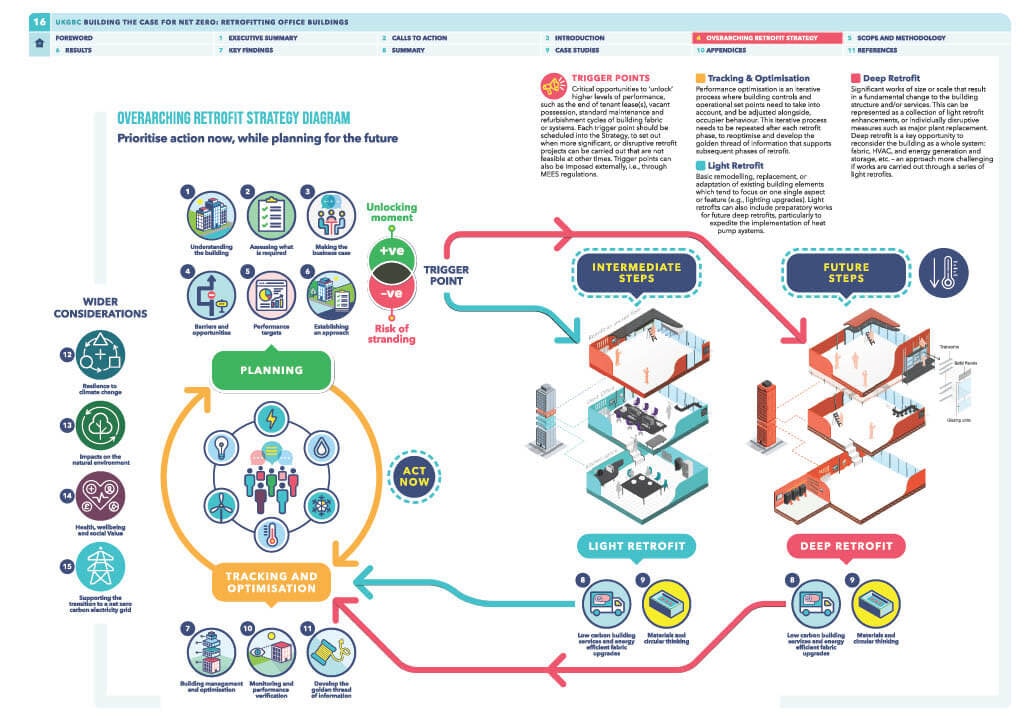
Optimisation – BMS upgrade / health check. • Reduce tenant equipment loads.

Light Retrofit – Pump motor replacement •Lighting controls •Low energy lighting

Deep Retrofit – Roof insulation •Building airtightness •Wall insulation •Window replacement • Decarbonisation of heat (ASHP) •ASHP for DHW

Figure 1. UKGBC finds significant opportunities being missed to retrofit commercial buildings | UKGBC

Significant reductions in operational energy use are possible through both optimisation and light retrofit (26% and 15% respectively or 37% combined), which generally include the most cost and carbon-effective retrofit measures. Optimisation and light retrofit can be landlord or tenant-led, and success depends on effective collaboration between all stakeholders. Deep retrofit is generally required to achieve significant cuts in operational energy use (60-65%), involving more substantial upgrades to a property. 

Importance of retrofitting in the built environment 

The UKGBC’s framework provides valuable insights for asset-owning businesses or individuals concerned about understanding the physical risks of climate change. It creates awareness for building owners and stakeholders who may not be fully aware of the benefits of retrofitting, or the potential funding opportunities available to support this. Average retrofit projects being carried out at this time are not reaching the reductions in operational energy performance required to meet top-down sectoral net zero targets. Efforts need to be redoubled and ambitions raised, to ensure the decarbonisation potential of future retrofit opportunities are realised. 

Large commercial building stakeholders possess the potential to lead by example in implementing retrofit strategies, to improve energy efficiency and contribute to the reduction in energy consumption within the office sector. Addressing these challenges will require a holistic approach, involving collaboration between government bodies, industry stakeholders, and guidance frameworks such as this UKGBC one, to create an environment where  retrofitting office buildings is at the forefront of businesses. 

Key considerations for our clients

The UKGBC’s framework highlights the importance of long term optimisation because it will change the way we use our offices, as building performance is balanced with employees’ health and wellbeing, shifts in flexible working, and alternative approaches to how, when, and where we work. Collaboration across all stakeholders is key to ensure all parties are invested in a net zero focused outcome, and that any unintended consequences of workplace shifts are fully considered. It represents a strategic investment, yielding financial savings, environmental advantages, and enhanced overall building performance, as delineated in the ten proposed strategies:

  1. Efficiency: Installation of modern technologies to reduce energy consumption and operational costs.
  2. Environmental Impact: Lowering carbon emissions and minimising the ecological footprint.
  3. Cost Savings: Long-term energy and operational cost savings.
  4. Compliance with Regulations: Ensuring adherence to evolving environmental regulations and building codes.
  5. Improved Comfort and Productivity: Enhancing indoor environments for occupants, positively impacting well-being and productivity.
  6. Increased Property Value: Conforming to evolving standards to avoid penalties and legal issues.
  7. Adaptation to Changing Needs: Reconfiguring spaces to accommodate evolving requirements and technologies.
  8. Technological Integration: Incorporating smart building technologies for enhanced operational efficiency.
  9. Long-Term Sustainability: Integrating sustainable practices for enduring building management.
  10. Government Incentives: Availing incentives and subsidies to offset initial costs and promote sustainable practices

How can Envision help? 

Retrofitting office buildings is imperative for addressing energy efficiency, carbon emissions and the evolving needs of businesses. Envision offers asset-owning businesses guidance in assessing and measuring the physical risks of climate change by establishing Net-Zero Pathways and Strategies, Asset Decarbonisation Plans, EPC Improvement Studies, BREEAM-In-Use benchmarking  and Life Cycle Assessments, all of which support portfolio level disclosures such as GRESB Our services align with the reporting requirements set forth by the UKGBC framework, empowering clients to make informed decisions for the future.

Phoebe Charnley

Filed Under: News

Healthy Buildings Guide

February 23, 2024 by Simon Rainsford Leave a Comment

Launching our new ‘Healthy Buildings Guide’

The onset of the coronavirus pandemic and the subsequent move back to office working has placed a spotlight on the importance of healthy buildings. Companies are increasingly prioritising spaces with credentials that support the well-being of employees. Sustainable development, meeting present needs without compromising the future, aligns with the broader concept of well-being – providing mental and emotional, social, and physical resources to face current and future challenges.

To guide us through these challenges, Envision has developed a comprehensive Healthy Building Guide. The guide defines the three pillars of healthy building design as physical health, social health and mental & emotional health, and how these should be explored holistically with the aim of designing and delivering more people-centred and health-enhancing places.

The guide also includes a useful comparative matrix of various Healthy Building accreditations prevalent in the UK market, as well as exploring how these align with established green building certifications like BREEAM.

Crucially, the guide emphasises the integration of healthy building principles across the building’s life cycle, and recognises the synergy between sustainable practices and the wider environmental, social, and governance (ESG) framework. Amidst the myriad sustainability and healthy building jargons prevalent in the market, Envision grounds these concepts in real-world design solutions.

Read our Healthy Buildings Guide.

Filed Under: News

BRE Fee Updates

February 22, 2024 by Simon Rainsford Leave a Comment

BRE Fee Increases – April 1st 2024

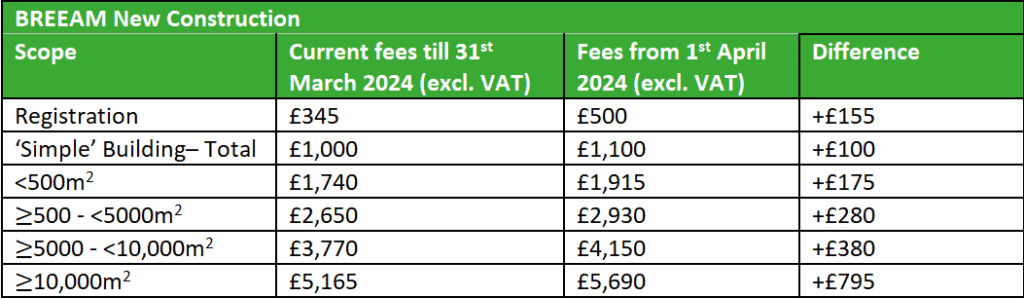
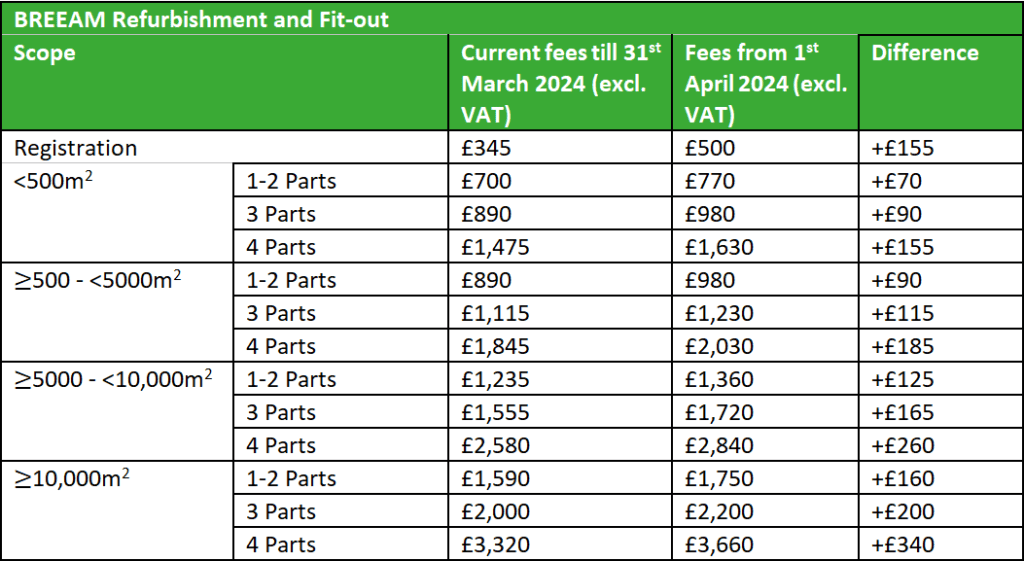
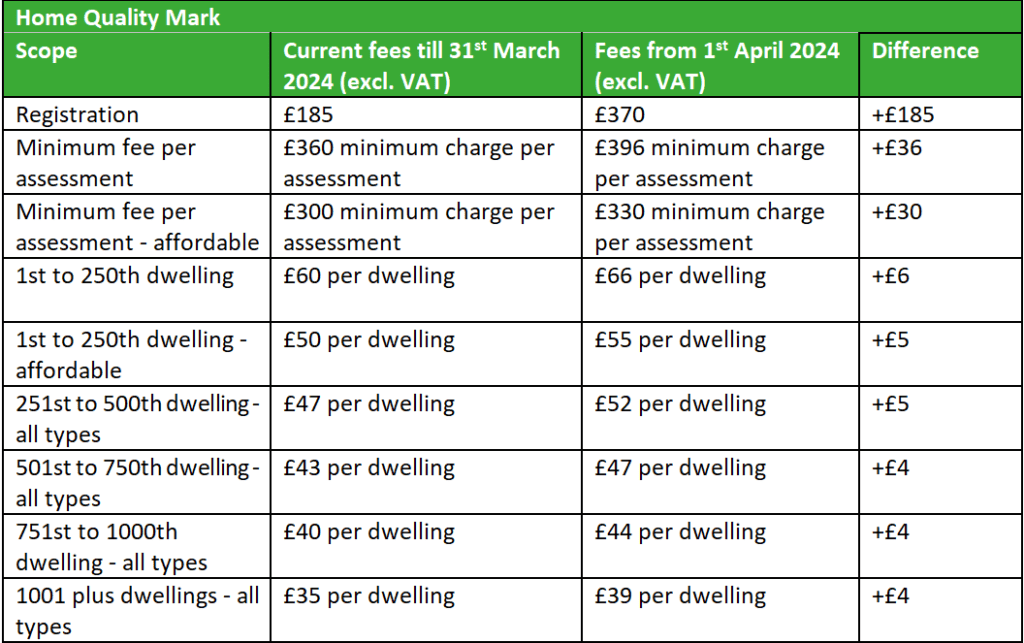
The BRE will be increasing prices for BREEAM/HQM registration, QA and certification across a number of schemes from 1st April 2024.

The existing fees can be locked in with the current prices where your schemes are registered before 1st April 2024. So, the last date for registration with the current fees is the 31st March 2024.

The tables below show the current fees, future fees and differences between them for BREEAM New Construction, BREEAM Refurbishment and Fit-out and Home Quality Mark.

Please get in touch with a member of the Envision team should you require your project registered in advance of this deadline.

Filed Under: News

2024 HealthInvestor Awards – Finalist

February 19, 2024 by Simon Rainsford Leave a Comment

Envision is pleased to announce that we have been shortlisted as a finalist for Consultants of the Year – Strategic at this year’s HealthInvestor Awards.  As a specialist advisor within the healthcare sector, this recognition shows the strong emphasis given to ESG in health investment.  

Why have we been nominated?

Environmental, Social and Governance considerations are becoming a major factor in health investing. Ensuring that care portfolios are fit for the next 30 years, Envision is leading the way in which property funds are analysing and managing ESG related risks and opportunities. Our support helps specialist funds, developers and care home operators embed ESG system thinking in their activities, enabling them to transition the UK health sector towards net zero faster than other countries. 

How are we supporting the specialist healthcare industry?

Envision specialises in providing strategic support to its clients and employs ESG analysts, low carbon consultants, life cycle specialists and BREEAM assessors, alongside a team of engineers who design and implement low carbon strategies.  We bring together a range of technical disciplines to evaluate sustainability opportunities available to a building or property portfolio. We specialise in asset benchmarking and apply our own bespoke techniques for appraising the performance of existing care home assets.  We help put in place cost effective strategies and action plans for improvement, taking account of payback and carbon reduction. We are leading providers of BREEAM in Use (BIU) benchmarking for the elderly care sector and have developed streamlined approaches to benchmark homes using BREEAM in Use Criteria to help achieve high ratings across property portfolio, whilst identifying priority issues for investment. 

ESG strategy – We continue to be a trusted advisor for many UK care developers, operators and funds. Helping to define best practices in care home investment and embed these practices in day to day operations.  We have helped a number of smaller operators who are developing a care portfolio to define ESG ambitions, including policy and process development fit for their business operations. We have drafted design guides to ensure that sustainability is a key factor in new care home design, facilitating sustainable outcomes in new buildings being brought forward. At the strategic level we continue to be a trusted ally of the largest UK heal care funds, retained to manage ESG related risk in existing portfolios, whilst ensuring that new investments are brought forward in ways which limit long term risk and maximise ESG benefits.  

Transactional Support – Our support has included the development of investment standards for ESG, enabling robust consideration of ESG related considerations through the acquisition process. We have been engaged in the due diligence of over 30 care home transactions over the past 12 months ranging through forward funding;’ standing assets and dept offers. Envision undertake detailed reviews of each transaction and provide diligence reports for investment committees to ensure that appropriate consideration is given to ESG, alongside the more conventional financial and legal issues dealt with already.  Our support helps to identify strengths and weaknesses of an investment from an ESG perspective and helps drive ESG consideration into the future of care homes in the UK. 

Disclosures and Transparency – We help various funds with their annual disclosures, including against the Global Real Estate Sustainability Benchmark (GRESB), which has seen significant uptake since its formulation. We are experts in this disclosure method and help portfolio owners to produce accurate and verified submissions which offer investment grade data. Over the past 12 months we have helped new entrants with their first disclosures within the non-listed healthcare sector, as well as supporting long standing clients achieve 5 star ratings, which represent exemplary performance within the industry. 

Independent Certification – Envision are leading providers of assessment services using the Building Research Establishment’s BREEAM Method. We have benchmarked over 140 care homes within the UK  against the BIU Framework on behalf of property funds, developers and care operators, many of which occurred over the past 12 months. The findings of these assessments provide independent certification which is recognised to have value across the industry from a leasing and investment perspective. Our expertise in this area has given Envision a unique insight into the sustainability challenges that are faced and enables us to provide costed and pragmatic advice for improving a care homes sustainability across a range of considerations, including energy and carbon performance, occupant wellbeing, biodiversity and climate resilience. 

Green Leases – a key challenge to achieving real world change is ensuring that clear agreements are in place between owners of healthcare real estate and their operators. In collaboration with leading property law firms, Envision has been working with funds and operators to develop meaningful lease terms which promote mutually beneficial outcomes for driving improvements in buildings over time. 

Net Zero Carbon Pathways and climate resilience – Like all sectors of the UK, the care home sector needs to move onto a pathway for achieving net zero to 2050. We have defined trajectories for care homes to be aligned with the Paris agreement pathways, limiting a homes contribution in line with a 1.5 oc climate scenario.   Envision employees building services engineers and experts in low carbon buildings to support this. Over the last 18 months the care sector has been hit hard with rising energy prices, meaning that transition towards energy efficiency has become a strategic imperative for care home operators and funds alike. Our analysis involves a review of existing utilities data for a care home to examine trends in consumption. We undertake a survey of the property and provide costed recommendations for reducing energy consumption whilst tackling carbon emissions. Our assessment includes feasibility of switching from gas led systems to heat pumps and opportunities for on-site energy generation to avoid stranding risks. We have undertaken considerable assessments over the past 12 months for care home funds and operators. 

The awards will be held on 5th June 2024 at the Grosvenor House Hotel, London. 

https://healthinvestorawards.com/finalists/

Filed Under: News

Latest GRESB Updates

January 18, 2024 by Simon Rainsford Leave a Comment

GRESB is the leading global real estate ESG reporting framework and benchmark, with over 2,000 participants in 2023 across 75 countries. The annual GRESB Assessment analyses ESG performance for real estate and infrastructure funds, companies, and assets globally.

The GRESB Real Estate Standard is continually evolving to reflect best practice in ESG, and the changes affecting the 2024 submission have recently been released. Katie Upton and Annie Schneidau explain these changes and their impact on future scoring. 

Management

A number of minor changes have been made to the management section, in order to streamline reporting, including through removing replication. While these updates are minor, this will affect the way the assessment is scored and approached. These include:

  • Minor changes to LE2, LE5 and LE6 to remove replication. This shouldn’t impact anyone significantly and is quite a good logical move. 
  • RP1: The option ‘Section in entity reporting to investors’ has been removed from the list of ESG disclosures, which previously could have scored 1.4 points
  • RP2.1: Communication of incident monitoring will now be scored, and this must be to at least 5 stakeholder groups to achieve the full 0.25 points.
  • RM1: Environmental Management Systems must now be either aligned with a standard or externally certified to achieve any points. The overall score for this section has been reduced to 1.25 points, and systems which are only aligned will score half of this now, rather than 5/6.
  • RM4: The total score available for ESG due diligence for new acquisitions has dropped from 0.75 to 0.25

RM5: Climate Resilience and Opportunities

In order to provide greater alignment with the Task Force on Climate-related Financial Disclosures (TCFD) framework, participants will now need to report not just on how they consider climate-related risks, but now also climate-related opportunities (CROs). There are a range of areas of opportunities as identified by the Task Force, through which organisations could realise cost savings or see growth, including:

  • Resource Efficiency
  • Energy Source
  • Products and Services 
  • Markets
  • Resilience

This section will now be scored, at 0.5 points.

With the disbanding of the TCFD in late 2023 and IFRS taking over the monitoring of progress of companies’ climate-related disclosures, it will be interesting to see what further updates GRESB include on this. 

Stakeholder Engagement

Whilst not included in the scoring until 2025, in order to ensure that sufficient data can be collated, GRESB has confirmed that the scoring of SE4, Employee Safety Indicators, will be changing for 2025, so that four metrics rather than the previous two must be recorded in order to achieve full points. 

Performance

Targets

From 2024, participants will be rewarded in T1.2 for having a net zero target, and the full point will be achieved by this, regardless of the methodology and requirements of the target. To accommodate this score, indicator T1.1, Portfolio Improvement Targets will drop from two points to one. Envision can help you to set ambitious and achievable net zero targets. 

Energy performance

In the first step towards providing an operational performance-based standard, energy efficiency will be scored from 2024 onwards, though the calculation of this is yet to be released. This won’t have a direct influence on the score for next year’s submission, and will just be a ‘supplemental insight’, however it is expected this will be fully incorporated in future years.

Energy performance reporting will see an update in the 2024 standard, with operational and non-operational energy consumption split out. This is expected to see further separation in future years, however, for 2024 the scope is just focusing on EV Charging. Whilst data availability may restrict this, the aim is for assets to not be penalised with their like-for-like scoring by having an increased uptake in EV charging. 

Building Certifications

Building Certifications have seen two updates for the next submission, firstly through the timing of validity – provided the certification is submitted for before the end of the reporting year and the certificate is received before the GRESB submission deadline, the certificate is now still deemed valid. This will result in scoring for this topic not being restricted by any delays in certification. 

The other update affecting building certifications scoring is that the impact of these will now decrease over time, reflecting the relevance of schemes. A time factor will be applied to both building certifications at the time of design/construction, and for operational building certifications, 

Other changes:

  • Residential portfolios can now report multiple energy ratings per asset, and reporting guidance has been clarified 
  • Medical Offices have been reclassified from ‘Office’ to ‘Healthcare’
  • Performance benchmarking and scoring will now be included at the country level, not just property sub-type
  • Intensity values of assets will be calculated for those with over >50% data coverage, previously 100%

Beyond 2024 – Future Changes

The GRESB Foundation has also published their Road Map for the future evolution of the Real Estate Standard. The indication is that future versions of the Standard (2025 onwards) will include advanced requirements in the following areas:-

  • Net Zero – further developments to continue to drive improvements in both operational and embodied carbon emissions
  • Biodiversity – inclusion of biodiversity indicators and performance metrics, linked with the work currently underway by the Taskforce on Nature-related Financial Disclosures (TNFD)
  • Diversity, Equity and Inclusion – scoring of DEI performance rather than just reporting
  • Physical Climate Risk – quantification of physical climate risks and integration of resilience into asset management, linked with the Physical Climate Risk Assessment Methodology (PCRAM)

These are all important elements of an asset management ESG strategy and Envision will be monitoring this evolution closely and will report back on these in future news. 

How Envision can help you:

Envision has experience working with numerous real estate funds on their GRESB journey, who range from first time participants to funds achieving and maintaining 5* status. We have a wide support offering, from initial Gap Analysis work, support in preparing the GRESB submission, Data and Report Verification and Assurance, as well as broader roles in supporting the development and delivery of specific ESG Targets If you would like to find out more, please get in touch via contact@envisioneco.com.

Filed Under: News

Embodied Carbon of Materials: A Guide

July 30, 2023 by Simon Rainsford Leave a Comment

The 2015 Paris Agreement on climate change calls for holding eventual warming “well below” 2°C, and for the pursuit of efforts to limit the increase even further, to 1.5°C. To achieve this, every individual, company and industry has a role to play.

[Read more…] about Embodied Carbon of Materials: A Guide

Filed Under: News

  • « Go to Previous Page
  • Page 1
  • Page 2
  • Page 3
  • Page 4
  • Page 5
  • Interim pages omitted …
  • Page 13
  • Go to Next Page »

Primary Sidebar

Recent Posts

  • Envision welcomes Chris Heyworth to the Board as non-executive director
  • We’re Hiring! Business Operations Administrator, London
  • HQM and BIU Residential – Alignment
  • GRESB’s Latest Approach to Rewarding Building Certifications 
  • The ‘Usual Suspects’ – Sustainable Innovation in High Embodied Carbon Materials

Recent Comments

No comments to show.

Archives

  • April 2025
  • March 2025
  • January 2025
  • September 2024
  • August 2024
  • July 2024
  • June 2024
  • April 2024
  • March 2024
  • February 2024
  • January 2024
  • July 2023
  • January 2023
  • October 2022
  • March 2022
  • February 2022
  • December 2021
  • September 2021
  • July 2021
  • May 2021
  • March 2021
  • December 2020
  • August 2020
  • July 2020
  • May 2020
  • March 2020
  • November 2019
  • October 2019
  • August 2019
  • July 2019
  • June 2019
  • May 2019
  • January 2019
  • November 2018
  • August 2018
  • July 2018
  • May 2018
  • April 2018
  • February 2018
  • January 2018
  • December 2017
  • November 2017
  • October 2017
  • August 2017
  • July 2017
  • June 2017
  • March 2017

Categories

  • Case Study
  • News
  • Team Member
CONNECT

Let’s collaborate

Let’s collaborate

Privacy(Required)
This field is for validation purposes and should be left unchanged.

contact@envisioneco.com
Navigate
  • Home
  • Sustainability Consulting
  • Our story
  • Our people
  • Join our team
  • Who we work with
  • In practice
  • News
  • Contact
  • Cookie Policy
  • Privacy Statement
London Office

8-9 Stephen Mews
Fitzrovia
London
W1T 1AF

020 7486 0680

Oxford Office

One St Aldates
Oxford
OX1 1DE

01865 598 698

© 2026 Envision. All Rights Reserved.
Privacy Policy    Cookies

Made by erjjio
Powered by 100% renewable energy

Made by erjjio
Powered by 100% renewable energy

© 2026 Envision. All Rights Reserved.
Privacy Policy    Cookies

Manage Cookie Consent
We use cookies to optimise our website and and our service.
Functional Always active
The technical storage or access is strictly necessary for the legitimate purpose of enabling the use of a specific service explicitly requested by the subscriber or user, or for the sole purpose of carrying out the transmission of a communication over an electronic communications network.
Preferences
The technical storage or access is necessary for the legitimate purpose of storing preferences that are not requested by the subscriber or user.
Statistics
The technical storage or access that is used exclusively for statistical purposes. The technical storage or access that is used exclusively for anonymous statistical purposes. Without a subpoena, voluntary compliance on the part of your Internet Service Provider, or additional records from a third party, information stored or retrieved for this purpose alone cannot usually be used to identify you.
Marketing
The technical storage or access is required to create user profiles to send advertising, or to track the user on a website or across several websites for similar marketing purposes.
Manage options Manage services Manage {vendor_count} vendors Read more about these purposes
View preferences
{title} {title} {title}